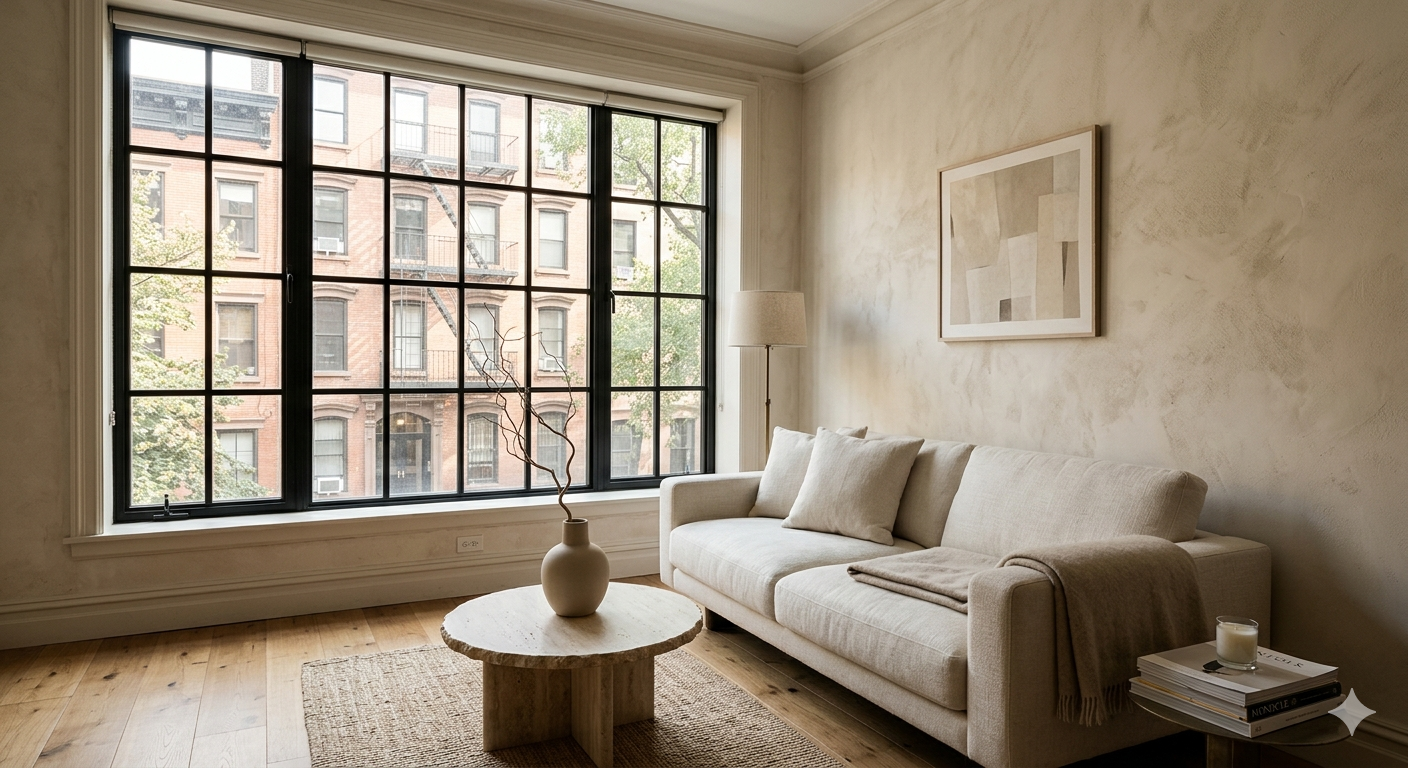
Small NYC Living Room Ideas That Feel Twice as Big and Effortlessly Luxurious
There is a particular kind of clarity that comes from living with less. Not the austerity of deprivation, but the quiet luxury of space considered—where every object earns its place and every corner is designed to breathe. In New York City, where 400 square feet can command a rent that would fund a small country, that clarity isn’t just aesthetic. It’s survival. And it’s the foundation of some of the most beautiful interiors in the world.
If you’ve ever stood in your Manhattan living room—wedged between a sofa that’s two inches too wide, a coffee table that exists purely out of obligation, and a window doing its absolute best against a brick wall—and wondered whether beautiful, expansive-feeling living is actually possible here, the answer is yes. Emphatically. These small NYC living room ideas aren’t about tricks or illusions. They’re about rethinking what luxury means when square footage isn’t something you can buy your way into.
Most people who finally get it right say the same thing afterward: they wish they’d started by taking things away, not adding them. It’s the quiet paradox at the heart of every genuinely successful small NYC living room transformation.
What follows is less a checklist, more a philosophy—and the most considered collection of small NYC living room ideas we know how to offer. A way of seeing your space differently, and then a set of precise, practical moves to transform it.
Redefining Luxury in Small NYC Living Rooms
The mistake most people make is equating luxury with size. More rooms, more furniture, more things. But walk through the best hotel suites in New York—the smaller ones at the Crosby Street Hotel, a well-appointed suite at 11 Howard—and you’ll notice something: they feel enormous, not because they are, but because everything in them was chosen with absolute precision. Nothing is accidental. Nothing is apologetic.
Publications like Architectural Digest have long documented this principle: the rooms that photograph as vast are rarely large. They are, without exception, deliberate. Luxury, in a small NYC apartment, is about three things: space, calm, and intention. A room that has even just these qualities will always feel more expensive than a cluttered one three times its size.
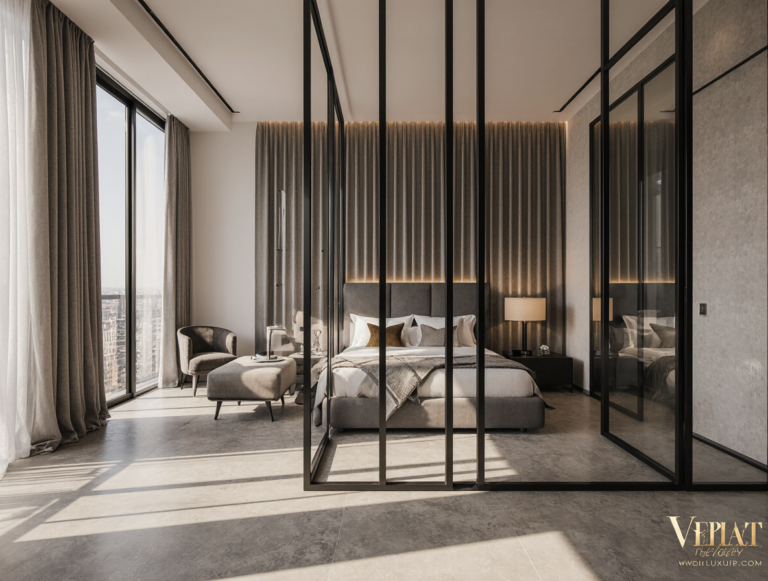
This means letting go of the idea that your living room needs to do everything—host dinner parties for twelve, function as a home office, double as a guest room—all at once. When you design for a primary purpose and then layer in flexibility, the space immediately gains coherence. And coherence is the quiet architecture of calm. If you’re navigating an open-plan studio, consider how Luxury Studio Partitioning can quietly define zones without sacrificing openness.
Before purchasing a single new piece, spend one afternoon removing things. A room that breathes before it’s decorated will always outperform one that doesn’t. Edit ruthlessly. What remains will tell you what the space actually needs.
How Light Can Instantly Expand Your Living Space
Of all the small NYC living room ideas worth committing to first, this is the one that costs nothing and changes everything: light. It is the single most powerful tool in small apartment living room design—more transformative than any piece of furniture, any color, any renovation. In New York, where north-facing apartments often get indirect grey light and south-facing windows are blocked by the building directly across the street, working with light isn’t always about maximizing the sun you have. It’s about manipulating how the eye perceives the room’s boundaries.
Mirrors: Placed with Purpose, Not Panic
The reflex move is to hang a large mirror on every available wall. Resist it. One well-positioned mirror—leaned against a wall opposite a window, or hung to reflect a lamp in the evening—does more work than a gallery of reflective surfaces. The goal is depth, not hall-of-mirrors disorientation. A full-length mirror in a narrow room makes the room feel longer. A round mirror above a low credenza gives the eye somewhere to travel vertically, drawing the ceiling up.
Layering Artificial Light
Nothing kills a small room faster than a single overhead fixture casting flat, indiscriminate light across every surface. The alternative is layering: a floor lamp in one corner throwing warm indirect light upward, a table lamp on a surface at eye level, perhaps a low-wattage sconce on the wall if your rental allows it. This creates pools of light and shadow that suggest zones within the room—and zones suggest space. The room doesn’t feel like a box. It feels like several small, considered areas that happen to share a floor plan.
- Position a lamp in the farthest corner from your seating. It pulls the eye—and thus the sense of space—deeper into the room.
- Use bulbs with a color temperature between 2700K and 3000K. Cooler light flattens; warmer light gives depth and shadow.
- Sheer curtains hung close to the ceiling (even above the window frame) make windows appear taller and let light diffuse softly across the room.
Light doesn’t just illuminate a room. It defines where it ends—and in a small apartment, making those edges disappear is everything.
Minimalism That Feels Warm and Livable
There’s a version of minimalism that looks perfect in a magazine and feels punishing to live in. Cold plaster walls, a single white sofa, one ceramic bowl on a shelf. Beautiful for thirty seconds. Miserable after a week. The minimalist living room NYC residents actually want is something different: edited, yes, but also warm. Tactile. Genuinely comfortable.
The difference between cold minimalism and warm minimalism is almost entirely material. A linen sofa reads as minimal. A white plastic one reads as cheap. A natural oak shelf with carefully arranged objects reads as intentional. The same shelf overloaded with tchotchkes reads as chaotic. When you strip back the volume, the quality of what remains becomes everything.
Decluttering with Intention
Go category by category rather than room by room—books, textiles, decorative objects, electronics. For each item, ask not just whether you need it, but whether it earns its visual weight in the room. A single beautiful art book on a coffee table contributes. A stack of six slightly battered ones mostly takes. Storage that hides is infinitely more valuable in a small space than storage that displays, unless what’s being displayed is truly worth showing.
This is particularly relevant in NYC apartment decor, where closets are frequently an afterthought and the living room ends up absorbing everything that doesn’t belong elsewhere. Ottomans with interior storage, consoles with deep drawers, benches at the end of a daybed—these aren’t compromises. They’re the infrastructure of a calm room. They are also, quietly, some of the most effective small NYC living room ideas available to a renter.
Smart Furniture and Small NYC Living Room Ideas for Functionality
In a 350-square-foot studio on the Upper West Side or a narrow one-bedroom in Astoria, furniture isn’t decoration. It’s architecture. Every piece defines how the room moves, how it breathes, and how generously it can be lived in. The wrong sofa can make an otherwise intelligent space feel irretrievably crowded. The right one can make it feel like a considered, cohesive whole.
For a deeper look at how layout thinking applies to kitchen adjacency in open-plan homes, Test Kitchen Ideas explores the same philosophy of proportion and flow in a different context. And Apartment Therapy’s small living room layout guide offers a useful practical counterpoint to the principles covered here.
Proportion Before Everything
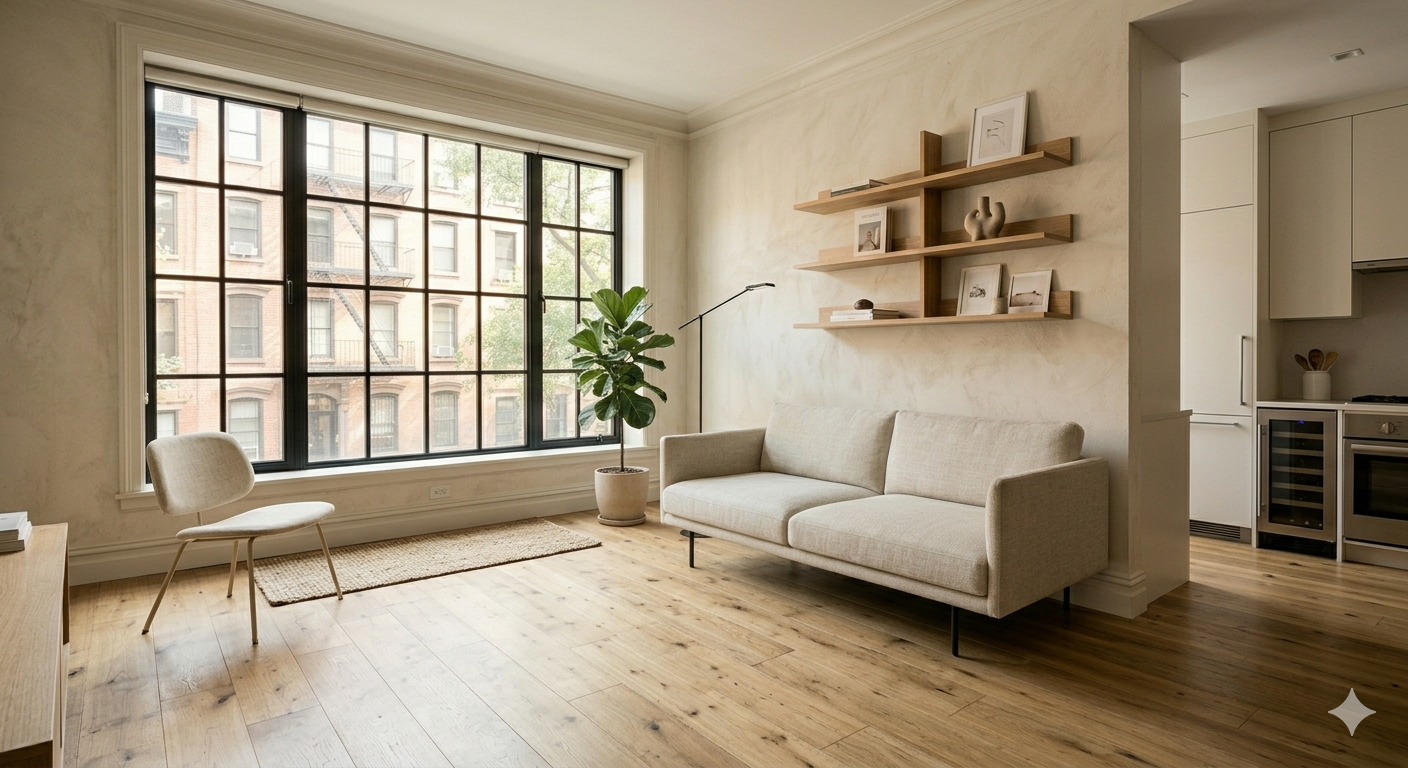
The most common mistake in small NYC living rooms is furniture that’s one size too large—a three-seater sofa in a room that wants a two-seater, a dining table that fits eight people who will never all come at once. Scale down. Not to miniatures or furniture that looks apologetically dainty, but to pieces with a lighter visual footprint: raised on legs rather than sitting flush to the floor, with narrower arms, slimmer profiles. A sofa on legs lets the floor run beneath it continuously, making the room appear larger. A sofa sitting on the floor cuts the room in half.
Multi-Functionality Without Compromise
The best multi-functional furniture is invisible in its versatility. A nesting table set that separates when needed, reunites when not. A daybed that works as a sofa all week and a guest bed on the one night a year someone actually stays. A console that functions as a desk behind the sofa. These pieces earn their place not because they do two things adequately, but because they do one thing beautifully and another when required. When it comes to small NYC living room ideas, multi-functionality is less a compromise than an upgrade.
- Float your seating. Pull the sofa a few inches from the wall. Counterintuitive, but a sofa against the wall makes a room feel smaller. Even eight inches of breathing room behind it changes the visual weight entirely.
- Use one anchor rug, properly sized. A rug too small is the single most common spatial error. In a typical NYC living room, an 8×10 is usually the minimum. All front legs of seating should sit on it.
- Limit the coffee table. Consider a low bench, a pair of small side tables, or nothing at all. Open floor space reads as square footage you actually have.
- Think vertically. When floor space is precious, shelving that runs to the ceiling stores more and draws the eye upward, making the ceiling feel higher.
Elevating the Space with Textures and Materials
Among the most underrated small NYC living room ideas is one that requires no renovation permit and no landlord approval: texture. In luxury small space design, texture is the substitute for volume. What a large room achieves through scale—the sense that there is richness here, depth, quality—a small room must achieve through the layering of materials. And in New York, where you almost certainly cannot paint the walls, change the floors, or alter the lighting fixtures without your landlord’s written blessing, material layering is also your primary design tool.
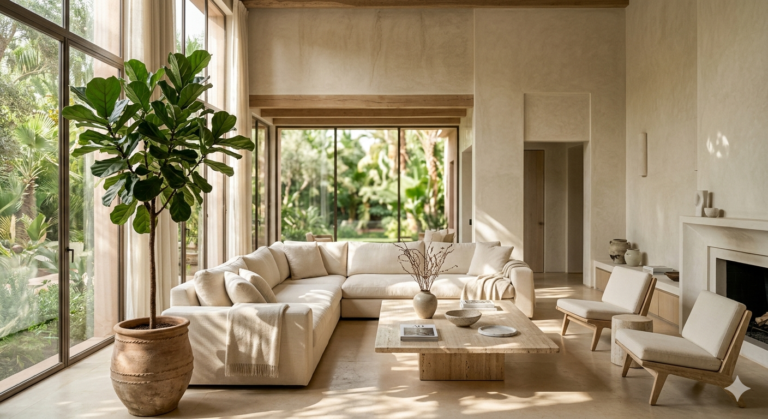
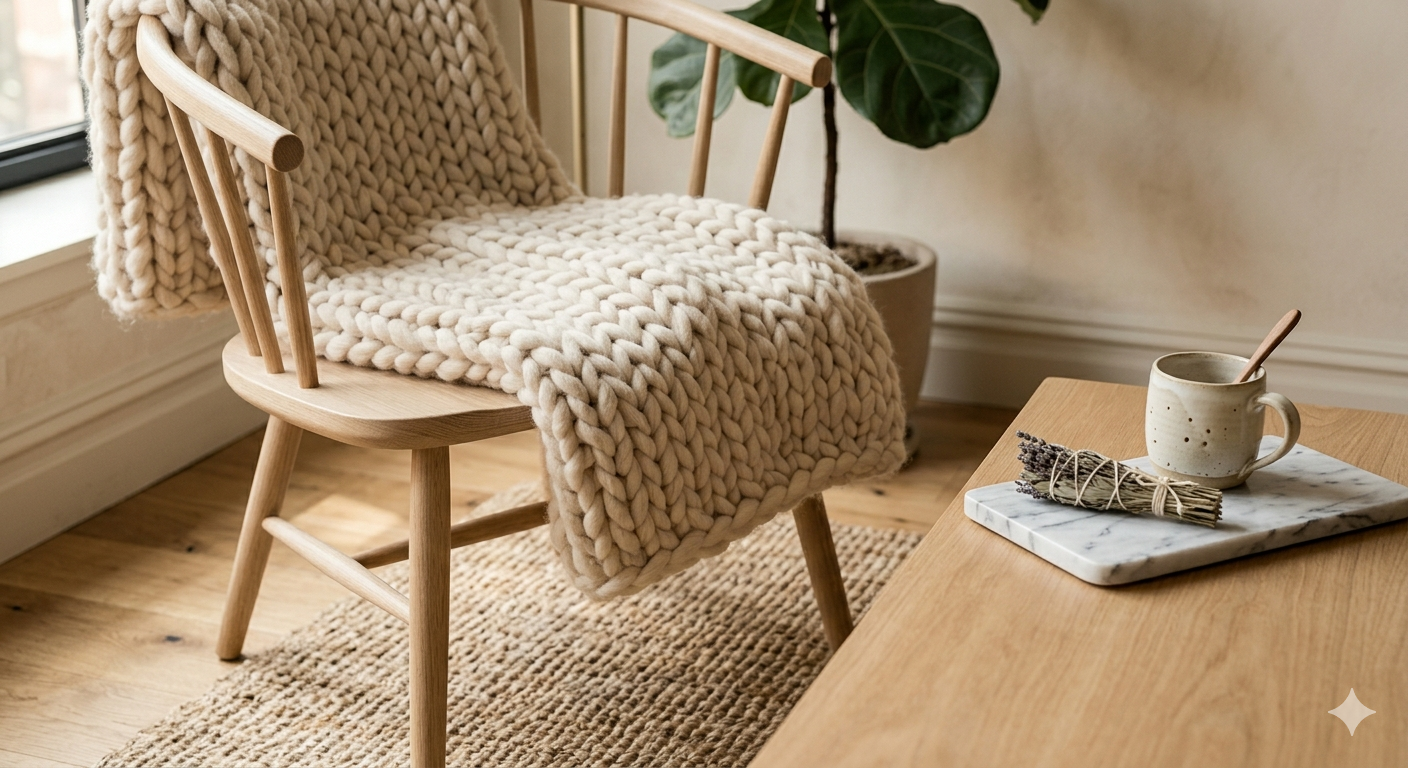
Start with a neutral tonal palette: warm whites, stones, taupes, the particular grey-beige of raw linen. These tones don’t compete with each other, which means the eye can rest rather than ping between visual noise. Into this, layer texture: a chunky natural wool throw over the back of the sofa, a jute or sisal rug underfoot, linen curtains that pool softly, a marble or travertine tray on the coffee table.
The Rule of Natural Materials
Wherever possible, reach for materials that have an inherent depth—wood grain, stone veining, woven fibers. These materials catch light differently throughout the day, which means your room changes as the light changes. Synthetic surfaces stay flat. Natural ones give the room something to do, a subtle animation that makes even a very simple space feel alive and considered.
A deeply saturated wall colour in a small room is not necessarily a mistake—it can make the room feel intentionally jewel-box intimate rather than merely cramped. The error is using dark colour arbitrarily. If you commit, commit entirely: dark walls, ceiling, and trim, with light furniture and reflective surfaces. Half-measures read as accident.
Common Design Mistakes That Make Small Spaces Feel Smaller
Most small NYC living room ideas fail not because they’re underfurnished, but because they’re over-complicated. Every design decision that adds visual noise, blocks sightlines, or fragments the floor plan chips away at the sense of space. Knowing which patterns to break is half the work—and often the faster path to a room that finally feels like itself.
- Too many competing focal points. A gallery wall, a large TV, a statement rug, and an accent chair all fighting for attention in the same 300-square-foot room don’t create interest—they create exhaustion. Choose one. Let everything else serve it.
- Curtains hung at window height. Hanging curtains at the window frame rather than at the ceiling is perhaps the most common and most correctable spatial mistake. Ceiling-height curtains add 18 to 24 inches of perceived height to any room at essentially no cost.
- Over-relying on cool or bright overhead light. As discussed earlier: overhead-only lighting flattens and diminishes. This single change—adding a floor lamp and removing the overhead—transforms more rooms than any piece of furniture.
- Wrong-sized rugs. A rug that floats in the centre of the room like a postage stamp does nothing but make the room feel tentative. Size up. The rug should anchor the entire seating arrangement.
- No negative space. Every surface covered, every wall filled, every corner occupied. The eye needs somewhere to rest. Negative space is not empty space—it’s the visual equivalent of silence, and it makes everything around it feel more deliberate.
- Ignoring the vertical plane. In a city of high ceilings (if you’re lucky) and low-clearance prewar buildings, the relationship between furniture height and ceiling height is everything. Keep large pieces low and let the upper third of the room remain open. The space overhead is what makes the room feel generous.
Questions Worth Asking
What is the best colour for a small NYC living room?
Warm neutrals—off-whites, soft taupes, and warm greiges—are the most forgiving and consistently effective choices. They reflect light without feeling clinical, and they don’t compete with the textures and materials that do the real spatial work. If you want something bolder, a fully committed deep tone (walls, ceiling, and trim in the same saturated colour) can make a small room feel intentionally intimate rather than merely small. The mistake is a half-measure: one dark accent wall in an otherwise neutral room tends to visually shrink the space rather than enliven it.
How do I make a 300–400 sq ft NYC apartment living room feel bigger?
Four changes, in order of impact: hang your curtains at ceiling height (not window height), layer your lighting with at least two lamps instead of relying on overhead fixtures, float your sofa a few inches from the wall rather than pushing it flush, and size up your rug so it anchors the entire seating arrangement. These four adjustments alone—none of which require landlord approval—will transform the perceived scale of the room more reliably than any new piece of furniture.
Can I decorate a rental NYC apartment without losing my security deposit?
Almost entirely, yes. The most impactful design levers—furniture proportion, rug size, curtain placement, lighting layering, material and texture choices—require no permanent alteration to the apartment whatsoever. For walls, removable picture-hanging strips can support artwork and mirrors up to a reasonable weight. The constraint of rental living, frustrating as it feels, actually sharpens the design process: it redirects attention toward the things that matter most, which are almost always movable.
What are the best small NYC living room ideas for rental apartments?
The most effective small NYC living room ideas for renters are those that require no permanent changes: ceiling-height curtains, layered lighting with floor and table lamps, properly sized anchor rugs, and furniture raised on legs. Beyond the hardware, the single highest-impact shift is editing—removing pieces rather than adding them. A room that breathes consistently outperforms one that’s fully furnished but overcrowded.
What furniture should I avoid in a small NYC living room?
Anything that sits flush to the floor with no visible leg—sofas, armchairs, and credenzas that block the floor plane make rooms feel heavier and more crowded. Oversized sectionals that dominate the layout. Coffee tables with a large visual footprint (a glass top on a slender base takes up far less visual space than a solid wood block of the same dimensions). And any piece that performs only one function in a space where every square foot needs to work harder than that.
Is minimalism the only style that works in a small NYC apartment?
Not at all—but minimalism is the most forgiving. The principle that actually matters in a small space isn’t style, it’s coherence. A maximalist room where every element is intentional, scaled correctly, and tonally unified can work beautifully in a small apartment. What fails, regardless of style, is incoherence: competing patterns, mismatched scales, objects that serve no purpose but haven’t yet been removed. Edit with confidence, then decorate in whatever language feels true to you.
How important is lighting in a small apartment living room?
More important than almost any other single factor. Flat, overhead-only lighting is the fastest way to make a room feel smaller than it is—it eliminates shadow, which eliminates depth. Layered lighting (a floor lamp, a table lamp, perhaps a sconce) creates distinct zones within a room, and zones suggest scale. A well-lit small room will consistently feel larger than a poorly lit one that’s twice its size. It’s also, usefully, one of the cheapest interventions available to a renter.
The Room You Already Have
The most extraordinary thing about applying these small NYC living room ideas is discovering how little needs to change—and how much that change matters. The constraint itself is the creative brief. You cannot sprawl. You cannot accumulate thoughtlessly. You cannot rely on sheer volume to do the work. Which means everything in the room has to be worth it—chosen carefully, placed deliberately, kept only as long as it earns its position.
That discipline, uncomfortable as it can feel at first, is the same principle that defines the finest interiors in the world. Not excess. Precision. Not more. Better. Every one of the small NYC living room ideas in this guide returns, in the end, to that single truth.
Your 400-square-foot living room in Brooklyn or your narrow pre-war front room on the Upper East Side is not a problem to be solved. It’s a canvas that demands a different kind of attention—and every small NYC living room idea offered here is an invitation to approach it that way. Start by taking something away. Then choose what stays with the same seriousness a curator brings to a gallery wall. The space you’ve always wanted is already there, waiting for you to clear the way—and VEPLAT is here to guide every step of that process.
The Small Space Edit: A Room-by-Room Design Checklist
A concise, printable guide distilling every principle in this article into a room-by-room checklist—furniture scale, lighting layers, material choices, and the six mistakes to avoid. Designed for NYC apartments, usable anywhere.
Shop the Edit
A considered selection of pieces that embody the principles in this article.
- Travertine Coffee Table Natural Stone · Low Profile
- Chunky Wool Throw Natural Fibre · Warm Neutral
- Slim-Legged Accent Chair Light Footprint · Open Frame
Some links may be affiliate links. Veplat only references products aligned with the editorial values expressed in this article.