Innovative Partitioning for Luxury Studios: The Logic of Spatial Silence
"A studio is not a small space. It is a concentrated space." This distinction — quiet, precise, and entirely non-negotiable — is the foundation upon which the most intelligent contemporary interiors are being built.
The Philosophy of Concentrated Space
There is a particular kind of courage required to inhabit a single room with full intentionality. Not the courage of resignation — of making do, of optimising the constraints — but the courage of the poet who chooses the sonnet over the novel. Concentration, in spatial terms, is a form of mastery. The luxury studio, when approached with the seriousness it deserves, becomes one of the most demanding briefs in contemporary residential design — and luxury studio partitioning is the discipline that answers it.
Across Tokyo, Paris, Copenhagen, and New York, a new generation of architects and interiors directors are confronting this brief with unprecedented sophistication. They are not dividing space. They are choreographing spatial experience — orchestrating the moment a room shifts register, the precise threshold where sleep becomes work, where the private self retreats from the social self. This is the art and science of luxury studio partitioning, and it operates according to principles as rigorous as any structural calculation — principles that underpin the VEPLAT editorial standards for residential spatial intelligence.
The conversation around luxury studio partition ideas has long been dominated by the functional: sliding doors, bookcase dividers, curtain rails. These solutions solve the problem of visual separation. What they rarely address is the deeper challenge: how to create a genuine sense of spatial identity — a true feeling of inhabiting distinct atmospheres — within a single envelope of air.
"The most successful partition does not divide a room. It creates two rooms that share a memory."— Veplat Editorial Board
The 3 Golden Rules of Studio Zoning
Through study of the finest executed luxury studio interiors — from the work of Axel Vervoordt to the minimal precision of Vincent Van Duysen, from Tokyo machiya conversions to Milanese penthouses — three governing principles emerge consistently. They are not rules in the prescriptive sense, but rather observable truths about what makes minimalist studio zoning succeed at the highest level.
One Axis of Visual Interruption
In a concentrated space, introducing multiple planes of division creates spatial anxiety rather than spatial clarity. The discipline of the single axis — one primary partition, one dominant gesture — allows the eye to resolve its reading of the room with confidence. This axis does not need to be a wall. It may be a change in ceiling height, a material threshold, a suspended volume. But it must be singular. The moment two competing axes are introduced, the studio begins to feel edited rather than designed.
The 12 cm Threshold Principle
Depth matters more than height in partition design. A partition element with a physical depth of at least 12 centimetres — whether expressed as a thick masonry reveal, a double-glazed frame profile, a folded steel shelf, or a recessed niche — registers in the body as genuinely architectural. Below this threshold, an element reads as furniture or decoration. Beyond it, the body understands it is approaching a boundary with its own interior life, its own shadow, its own acoustic behaviour. The 12 cm depth is the minimum credential of spatial authority.
Light Must Travel, Sound May Pause
The highest-performing luxury studio partitions resolve a fundamental tension: they maintain visual continuity and the passage of light across the full depth of the plan, while simultaneously providing acoustic differentiation between zones. A sleeping zone does not require blackout; it requires a reduction in ambient noise below 35 dB. A working zone does not require hermetic sealing; it requires the sense that one's concentration is protected. Materials that allow light to pass — ribbed glass, open wood slats, perforated bronze mesh — while absorbing mid-frequency sound achieve this ideal.
Partition Typologies & Material Language
The vocabulary of luxury studio partitioning at the highest level is a vocabulary of materials before it is a vocabulary of forms. The form — a plane, a screen, a volume — is merely the carrier. It is the material that communicates warmth or restraint, age or precision, the natural world or the industrial one. Four primary typologies have emerged as the dominant language of contemporary luxury studio design.
Typology I
Structural Glass
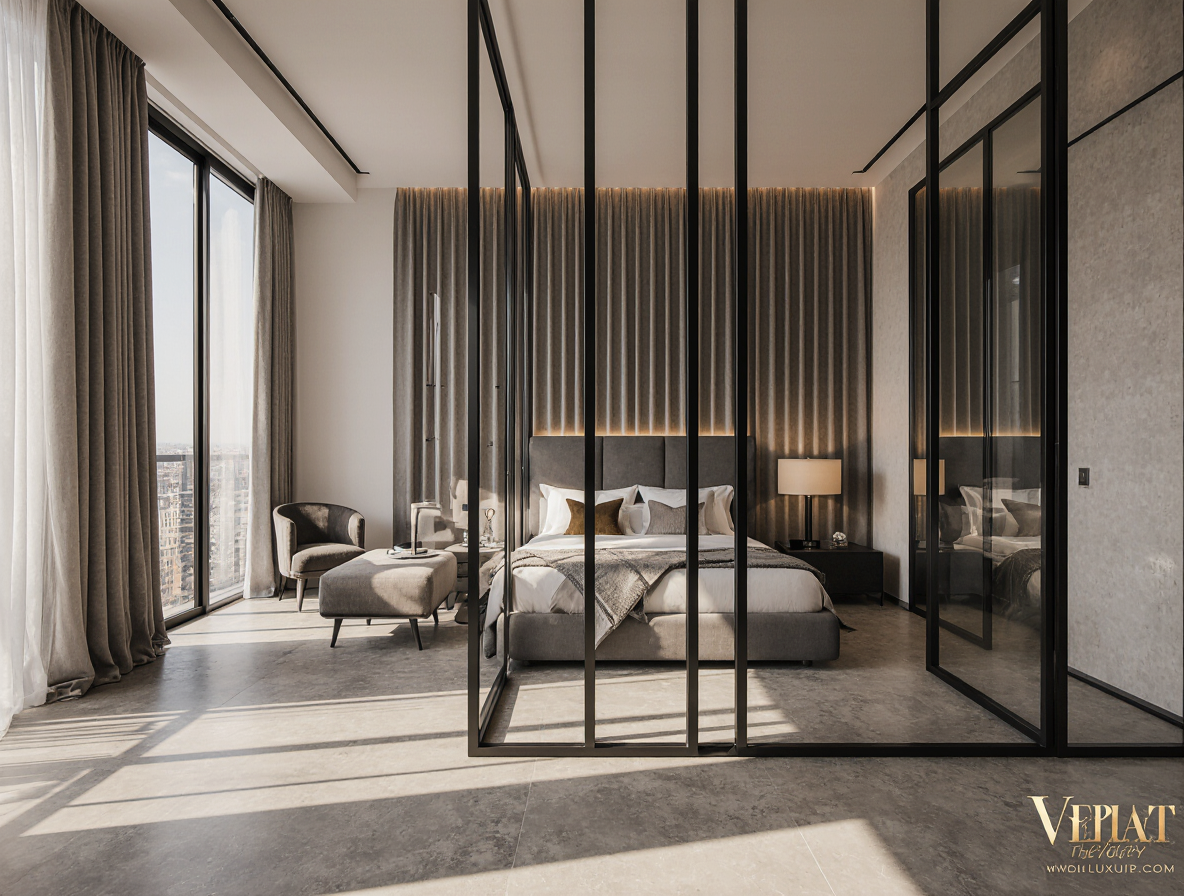
In its most resolved expression, glass partitioning operates as an act of radical transparency — not privacy, but presence. Frameless panels of low-iron glass or smoked borosilicate maintain visual continuity while establishing an unmistakable material boundary. The glazed partition does not hide; it frames. The bedroom seen through a glass wall becomes a painting the living zone observes.
Typology II
Wood Slat Screens
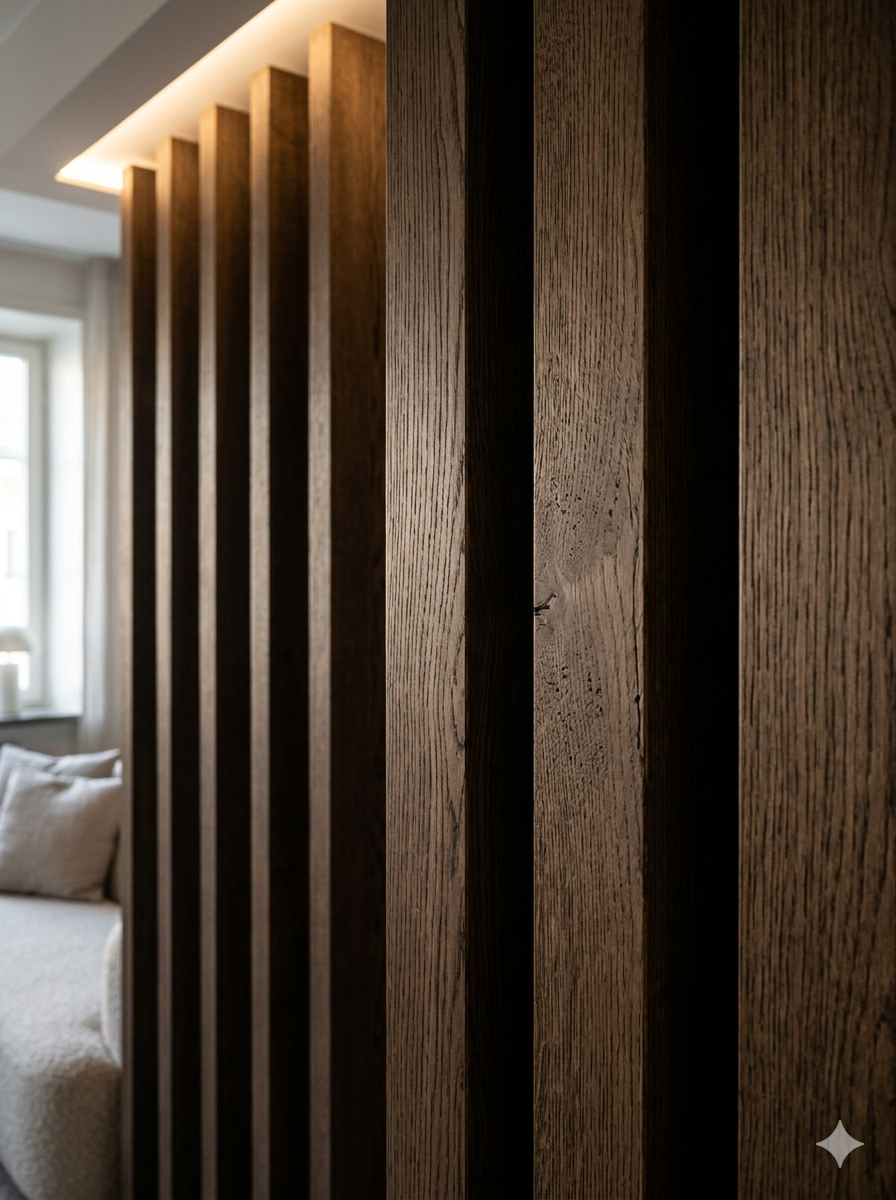
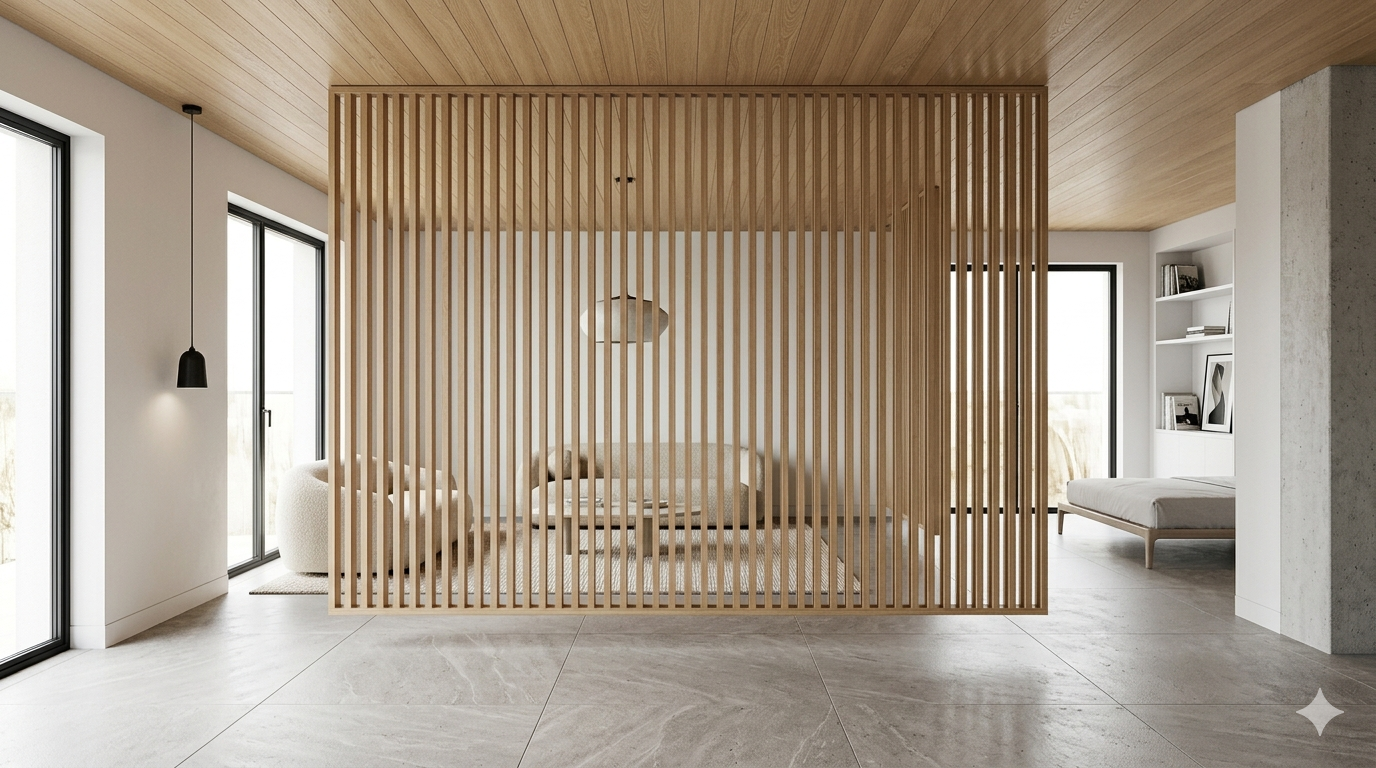
Among all typologies, the wood slat screen best satisfies all three Golden Rules simultaneously. Its depth exceeds the 12 cm threshold. Its linear rhythm allows light to travel while creating genuine acoustic diffusion. In smoked oak, the material carries a quality of restrained antiquity: the grain is visible but quieted, the tone cool and forest-dark.
Typology III
Textile Volumes
Linen, heavy wool, and leather-waxed canvas — suspended from concealed ceiling tracks — represent the softest end of the partitioning spectrum. Their acoustic performance is, weight for weight, among the highest of any partition material. In a studio designed to be lived in alone, the textile partition offers the suggestion of embrace. These elements respond to air movement, carry scent, and age visibly.
Typology IV
Architectural Volumes
The most ambitious strategy involves a freestanding architectural volume: a service core clad in travertine, a millwork box with concealed bathroom, a patinated bronze cabinet that reads as sculpture at a distance. These elements do not divide space so much as they generate it — creating residual spaces with their own distinct character.
Material Logic: The Comparative Table
The selection of partition material in a luxury studio is never merely aesthetic. Each material carries a specific and measurable relationship to light, sound, and use. The following table presents the principal materials available to the contemporary studio designer, assessed across the dimensions that matter most in concentrated space. The same logic extends to ancillary zones: for those exploring the relationship between partitioning and service areas, our analysis of minimalist kitchen layouts addresses how these principles translate into culinary sequences within compact plans.
| Material | Tactile Quality | Light Transmission | Acoustic Privacy | Best Use Case |
|---|---|---|---|---|
| Smoked Oak Slats | Cool, slightly rough; grain quietly present; ages with warmth | Filtered — diffused between slats, directional shadow | Moderate (mid-frequency diffusion) | Living-to-sleeping zone in contemporary or Japanese-influenced interiors |
| Travertine Panel | Cold to touch, heavy, porous; fossilised quiet | Opaque; creates deep shadow recesses | High (mass-loaded acoustic barrier) | Freestanding service core; bathroom or kitchen concealment volumes |
| Low-Iron Glass | Hard, cold, imperceptibly green edge; mineral clarity | High — near-total passage of visible light | Low without acoustic laminate; high with specialist glazing | Studios requiring visual openness; bedroom transparency effects |
| Smoked Borosilicate Glass | Hard, amber-grey in tone; filters light to warmth | Medium — diffuses and warms light passage | Low to moderate | Dressing zones; low-privacy visual separation in warm palettes |
| Patinated Bronze Mesh | Cool, slightly rough; oxidation develops over years; museum-quality ageing | Medium-high — open weave permits light with visual diffusion | Low (primarily aesthetic boundary) | Dressing rooms; decorative screens; library-to-living transitions |
| Heavy Linen (suspended) | Warm, soft, breathing; responds to occupancy and air | Diffuse — glows when backlit; absorbs when front-lit | High (NRC 0.75–0.90 for heavy textiles) | Sleeping zone seclusion; softening of hard material environments |
| Fumed Ash Panelling | Dark, uniform; almost lacquered; precise and recessive | Opaque; absorbs light into surface | Moderate-high (dense panel construction) | Work alcoves; studies requiring psychological separation from domestic zones |
| Raw Plaster Volume | Powdery-smooth; matte; absorbs and holds ambient colour | Opaque; acts as reflective diffuse surface | High with adequate thickness (≥ 100 mm) | Integrated architectural volumes; built-in storage walls |
Spatial Application & Composition
Understanding the material is the beginning of the discipline. Understanding how materials are composed in plan and section — how they relate to the existing architecture, the direction of light, and the daily choreography of the inhabitant — is the practice itself.
The Axis in Plan
In a rectangular studio plan — the most common configuration — the partition axis runs either parallel to or perpendicular to the primary window wall. The perpendicular approach creates an immediate hierarchy: a light zone and a dark zone. The parallel approach, running the partition at a depth of roughly one-third of the total plan depth, creates two zones of equivalent daylight access. Both the sleeping zone at the rear and the living zone at the front receive direct window light; the partition itself becomes a backdrop for both.
The Floating Threshold
One of the most elegant technical solutions in contemporary minimalist studio zoning is the partition that reaches neither the floor nor the ceiling. A panel suspended 150–200 mm above the finished floor and terminating 300–400 mm below the ceiling plane reads as a genuinely architectural element while preserving the continuous perception of the room's full height and allowing air to circulate freely. This configuration simplifies the acoustic calculation: without hermetic sealing, acoustic separation derives from diffusion and absorption rather than isolation.
Material Continuity Across the Threshold
The highest-quality studio interiors treat the partition not as an interruption of the floor plane but as a guest of it. When the floor material — a single continuous field of large-format limestone, or wide-plank white oak — passes beneath the partition without interruption, the zones it separates feel like chapters of a single narrative rather than different stories. This detail is rarely noticed consciously by the occupant. But its absence is immediately felt.
Luxury Studio Partitioning: Technical Considerations
The ambition of luxury studio partitioning is realised in detail. The following technical considerations represent the minimum threshold of resolution for work at this level.
Acoustic Performance Targets
In residential studio applications, the sleeping zone should target an ambient noise level below 35 dB(A) during occupation. This is not achieved by the partition alone; it is the result of a system that includes the partition, ceiling and floor treatment, and the acoustic behaviour of all material surfaces in both zones. A single heavyweight linen panel will reduce ambient sound transmission by 8–12 dB — meaningful, but rarely sufficient on its own. Combined with a ribbed oak backing panel on the living zone side, the attenuation increases to 18–24 dB, approaching the threshold of genuine privacy.
Structural Integration
Freestanding partition volumes — particularly those conceived as architectural gestures in travertine, concrete, or steel — require structural coordination with the building's slab and, in many cases, a dedicated point-load transfer solution. The most frequently overlooked detail is the connection between the partition volume and the ventilation system: a freestanding stone volume positioned without regard for existing HVAC zones will create thermal asymmetry between the two sides of the partition.
The Question of Reversibility
Luxury studio partitioning must navigate an inherent tension between architectural permanence and spatial flexibility. The most valuable interventions are those that read as permanent — that carry the visual authority of architecture — while being technically reversible. Ceiling-track suspension systems for textile and glass panels, freestanding millwork volumes anchored with concealed floor bolts, and pre-fabricated stone-clad structures that demount without damage to the host building represent the current state of the art in reversible luxury partitioning.
"Concentration, in spatial terms, is not a compromise of ambition. It is ambition's purest form."— Studio Logic, Vol. IV
People Also Ask
What is the most effective partition type for a luxury studio apartment?
There is no single answer, because effectiveness is always relative to programme and palette. For studios where natural light is the primary luxury, a smoked glass panel or a ribbed oak slat screen will outperform any opaque solution. For studios in acoustically demanding locations, a heavyweight textile panel or mass-loaded architectural volume delivers better acoustic performance. The highest-performing solutions combine typologies: a structural element for acoustic mass paired with a translucent layer for light control.
How can I zone a studio apartment without building permanent walls?
The vocabulary of non-permanent luxury studio zoning is broader than most expect. Ceiling-track suspension systems allow glass, textile, and timber panel configurations of genuine architectural weight to be installed and removed without structural alteration. Freestanding millwork volumes — designed with concealed floor anchoring — read as built-in architecture while remaining demountable. Material changes in the floor plane create a powerful psychological threshold with zero physical intrusion.
What materials are used in high-end studio partitions?
The material canon of luxury studio partitioning centres on substances that carry both tactile authority and visual restraint. Smoked oak and fumed ash represent the warm end of the timber spectrum. Travertine provides stone gravitas at a weight appropriate for residential applications. Patinated bronze, used as mesh or flat panel, occupies the metallic register with appropriate softness. These materials are selected not for trend — but because their ageing properties, acoustic behaviours, and relationships to natural light have been tested across decades of high-quality interior work.
How do I create privacy in a studio without sacrificing light?
The answer lies in understanding that privacy is primarily acoustic and behavioural, not visual. The human need for a sleeping zone to feel private is largely satisfied when sound transmission is reduced and the visual connection to active zones is filtered rather than eliminated. A ribbed oak slat screen at 30-degree rotation achieves this precisely: it reduces direct sightlines while allowing the passage of lateral light. Pair this with a linen panel on a parallel track for periods of complete visual separation, and the system becomes fully modular — serving transparency by day and enclosure by night.
Is architectural studio partitioning worth the investment for renters?
The question of investment returns in rental contexts is a function of duration and reversibility. For occupancies of three years or more, a well-designed non-permanent partition system will deliver a daily quality-of-life return that amortises the initial investment rapidly. The more important consideration is the design intelligence applied: a poorly conceived partition degrades the spatial experience of a studio regardless of material cost. A beautifully resolved solution — even one executed in modest materials — transforms the fundamental condition of concentrated living. Approached with intention, luxury studio partitioning is always worth the investment.
Every luxury space
begins with a considered silence.
Explore the full Veplat Studio Logic archive — an ongoing investigation into concentrated living at its most refined.
Enter the Archive