Feng Shui Interior Design:
The Quiet Intelligence
of Intentional Space
What the ancient philosophy of energy flow can teach a New York renter about living beautifully — and deliberately — within 600 square feet.
Before you rearrange a single piece of furniture, consider this: every room you have ever walked into has spoken to you before you had a chance to speak to it.
Not in words. In atmosphere. The kind that tightens your chest slightly as you step into a cluttered hallway, or loosens your shoulders the moment you enter a room where everything is simply — right. Where the light falls the way you hoped it would. Where there is air between things. Where the space seems to breathe.
This is not poetry. It is physics, psychology, and — for those willing to look further — ancient spatial philosophy. Interior designers have long understood what now neuroscience confirms: the physical arrangement of our environments shapes our cognitive load, our cortisol levels, our sleep quality, and the quality of our creative thought.
For urban renters navigating small apartments in cities like New York, this idea carries particular urgency. When your studio is also your office, your sanctuary, and your social space, the question of how to arrange it becomes less aesthetic and more existential. Feng shui interior design, reinterpreted through a modern, minimalist lens, offers one of the most coherent and practical answers.
What Is Feng Shui Interior Design?
Ask ten people what feng shui means and you will hear about lucky coins, red doors, and mirrors facing beds. This is the mythology that surrounds it — useful for selling trinkets, irrelevant to the practice itself.
The more precise answer: feng shui interior design is the choreography of energy through space. Originating in ancient China, feng shui — translated literally as “wind-water” — is a system of spatial philosophy that concerns itself with the movement of Chi (also written Qi), the vital life force that flows through all environments and living things.
The fundamental premise of feng shui interior design is elegant: when Chi flows freely, harmoniously, and without obstruction through a space, its occupants feel more vital, more focused, and more at ease. When Chi stagnates — blocked by misplaced furniture, obscured by clutter, disrupted by harsh angles — it is felt as unease, fatigue, or creative paralysis. You may never name it as such, but you have experienced both.
“Feng shui is not decoration. It is the invisible architecture of how energy — and therefore human experience — moves through a room.”
In its modern application, feng shui interior design has shed its more superstitious elements and converged with the disciplines of environmental psychology, biophilic design, and minimalist spatial theory. The practitioner today is less concerned with compass directions and more with sightlines, furniture placement, light quality, and the ratio of emptiness to object — the same concerns, in other words, that guide the editors of Kinfolk and the architects of Japanese ma (negative space).
For the urban renter, this feng shui interior design convergence is particularly useful. You need not believe in Chi to benefit from its logic. You need only recognize that space is not neutral — and that designing it deliberately changes everything.
The Core Feng Shui Interior Design Rules
The practice carries a deceptively simple set of foundational principles. Master these, and the philosophy becomes a practical tool rather than an abstract idea.
Rule 1: The Command Position
The command position is the most immediately applicable feng shui interior design principle — and the one most directly supported by behavioral science. The rule: your primary piece of furniture in any room (your bed, your desk, your sofa) should face the door without being directly in line with it.
The reasoning is primal. When we cannot see the entrance to a room from where we rest or work, our nervous system remains in a low-grade state of alert — scanning for threats we cannot see. This is not superstition; it is the same instinct that made our ancestors position themselves with their backs to cave walls.
In a New York studio apartment, this single adjustment — moving your desk so it faces the entry, or angling your sofa away from a wall to create a sightline — can measurably reduce ambient stress and increase your sense of safety and sovereignty within your own space.
Rule 2: The Five Elements
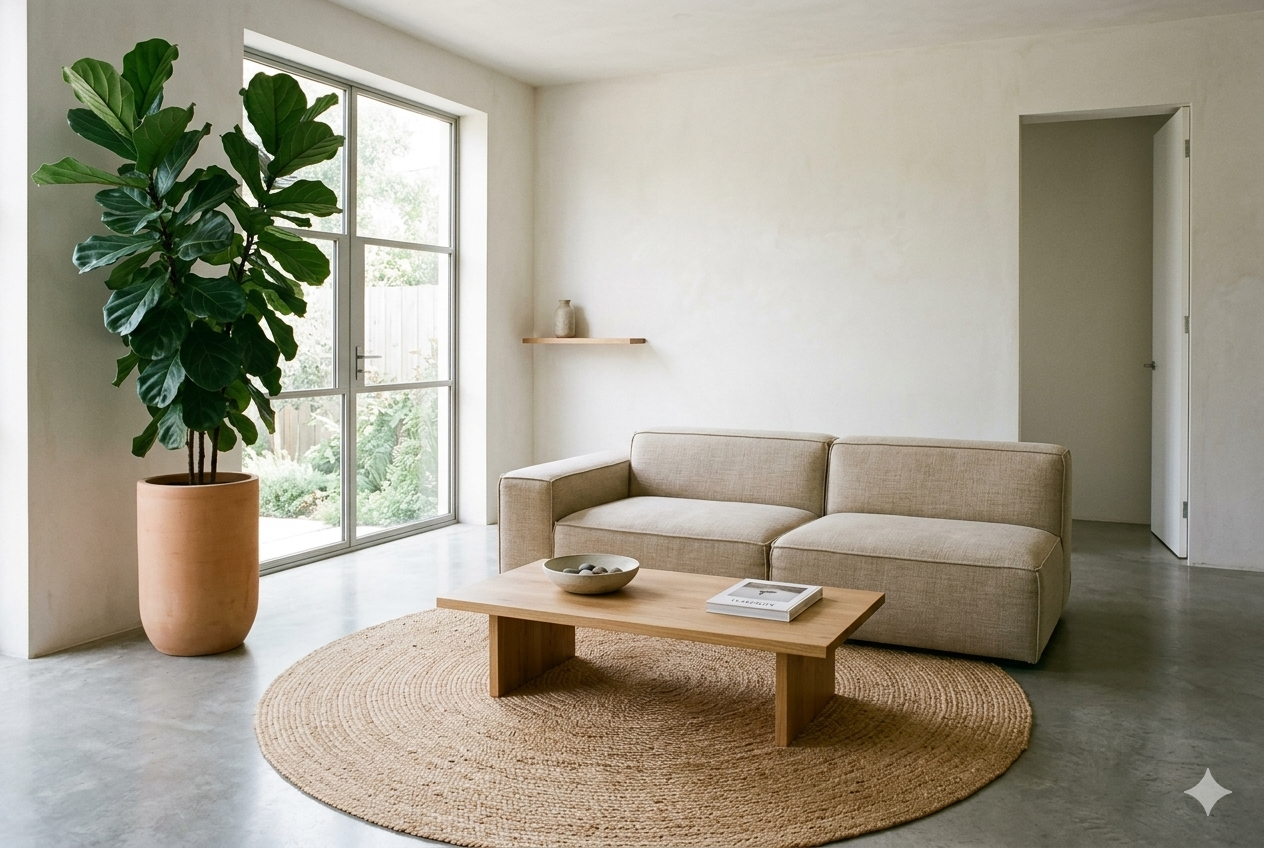
Feng shui organizes the natural world into five elemental archetypes, each carrying a specific energetic quality. A balanced room contains all five, in proportion. A room that overexpresses one and neglects another will feel either sterile or overwhelming.
In practical terms: a studio apartment rendered entirely in white linen and brushed steel (pure Metal energy) will feel clinical and cold regardless of how tasteful the individual pieces are. Introduce a terracotta vessel, a trailing vine on a shelf, a single warm-burning candle — and the room exhales.
Rule 3: Visual Clarity
The third rule is perhaps the most demanding and the most transformative: Chi cannot flow through what it cannot move through. Clutter — physical, visual, and conceptual — is the single greatest obstruction to both energetic flow and cognitive peace.
Visual clarity does not mean emptiness. It means that every object in the space has been chosen deliberately, placed intentionally, and serves either a functional or an emotional purpose — preferably both. Objects that are “stored” in plain sight, that have no home, that accumulate without curating — these create visual static that taxes the mind at a cost most renters never account for.
For small apartments, this principle makes smart storage and clutter management a non-negotiable design priority, not an afterthought. Every serious feng shui interior design practitioner and minimalist editor agree: what you remove is as important as what you keep.
Rule 4: Honour Your Thresholds
In feng shui, entryways and thresholds are considered the “mouth of Chi” — the point at which energy enters the home and sets the tone for everything that follows. An obstructed, dim, or neglected entry signals stagnation before a guest has removed their coat.
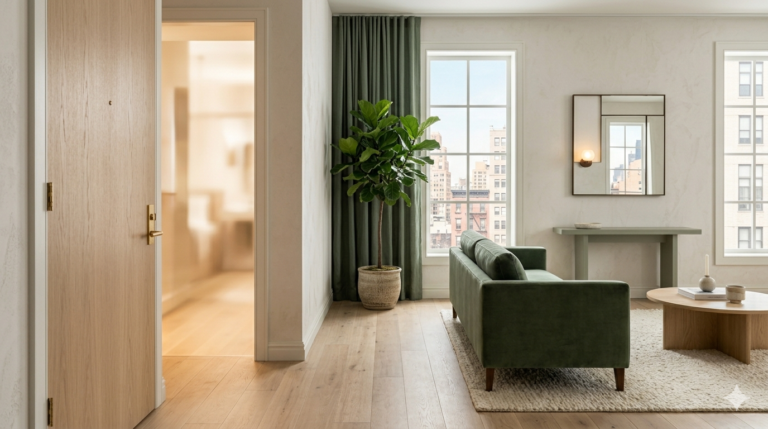
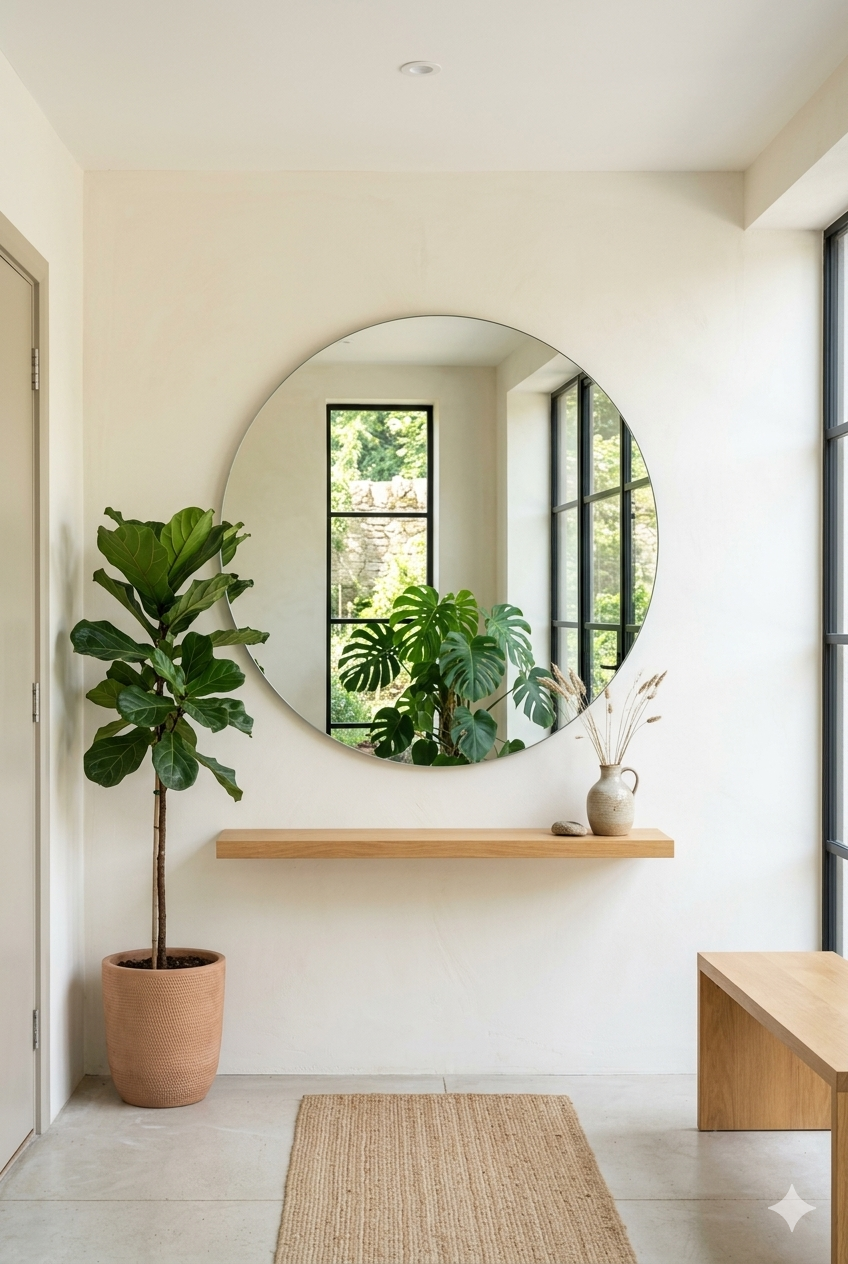
Even in a studio apartment with a modest eight-foot entry corridor, small interventions carry outsized impact: a single pendant light positioned at the door, a thin console with one considered object, a clear, uncluttered floor. In feng shui interior design, the threshold is a psychological reset — the transition from the city’s noise into your curated quiet.
Rule 5: Light as Living Element
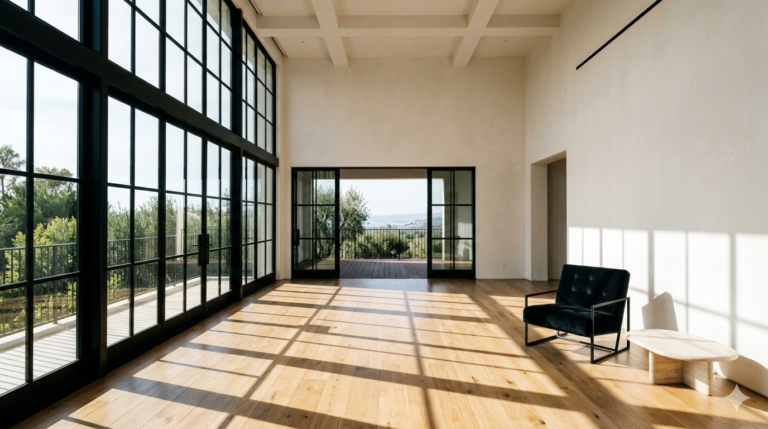
Feng shui classifies light — both natural and artificial — as a primary carrier of Yang energy (active, vital, warm). Spaces starved of natural light accumulate Yin energy (passive, still, heavy) disproportionately, resulting in rooms that feel heavier and smaller than their dimensions warrant.
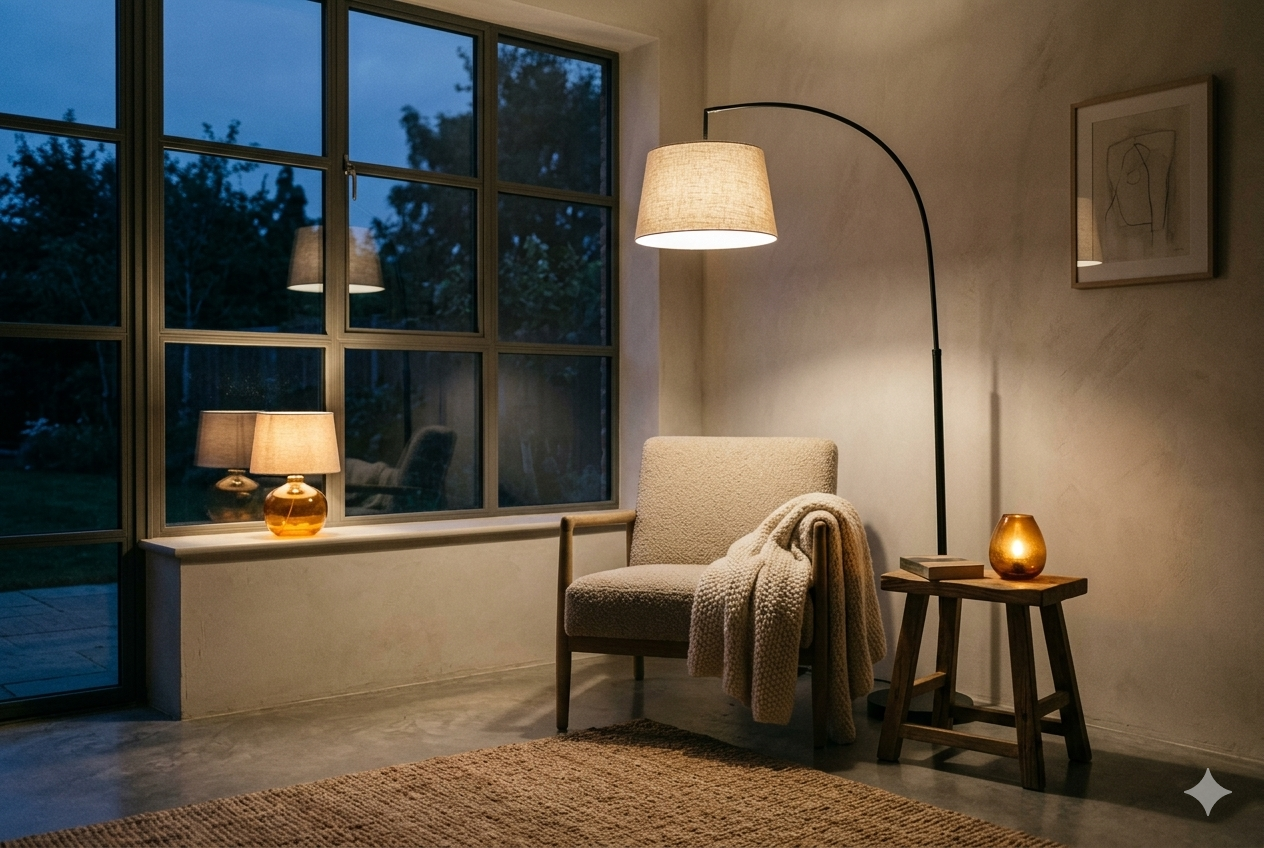
The prescription is layered lighting design — including sconces and task lighting that allows you to modulate the room’s energetic register throughout the day. A single overhead fixture is the spatial equivalent of a conversation at one volume only. Layered light — ambient, accent, directional — gives a room its full dynamic range.
| ✦ Do This | ✕ Avoid This |
|---|---|
| Place your desk or bed in command position — facing the door, not against it | Position your back to the room’s entry while sleeping or working |
| Introduce all five elements in proportion: wood, fire, earth, metal, water | Over-rely on one element (e.g., all-white, all-grey, or all-wood interiors) |
| Keep floor paths clear and unobstructed — Chi moves like a gentle river | Block natural pathways through rooms with furniture or accumulated objects |
| Layer lighting at multiple heights — floor, mid, and ceiling level | Depend solely on overhead fluorescent or a single central fixture |
| Curate your entry threshold: clear, lit, and considered | Use your entryway as a secondary storage zone for shoes, bags, or coats |
| Bring in living elements — plants, natural stone, organic materials | Fill shelves with synthetic objects that lack tactile warmth or natural origin |
| Create deliberate empty space on surfaces and walls | Gallery-wall every surface, leaving no room for the eye — or energy — to rest |
| Choose curved, organic furniture forms to soften Chi flow | Accumulate sharp-cornered furniture pointed toward seating or sleeping areas |
The Bedroom Sanctuary
Of all the rooms in a home, the bedroom commands the greatest feng shui interior design attention — and for good reason. We spend a third of our lives within its walls. What happens in that room, energetically and atmospherically, has a direct and measurable effect on the quality of our sleep, our emotional regulation, and our capacity for intimacy and restoration.
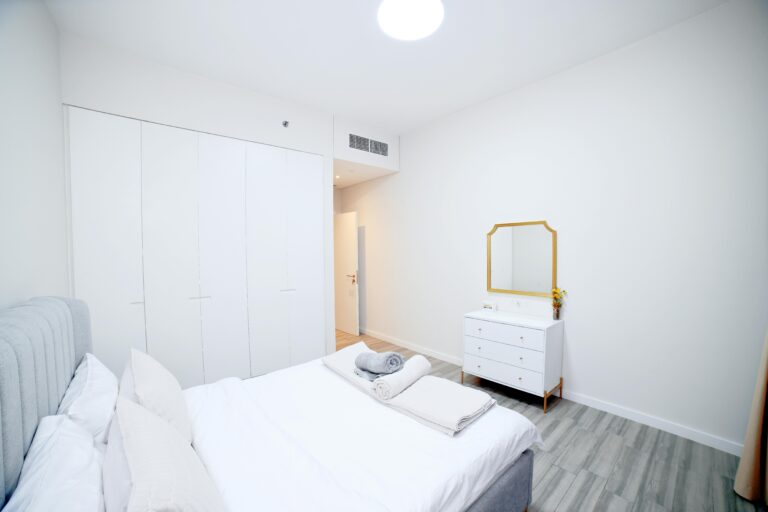
The feng shui interior design bedroom principles are among the practice’s most specific — and most practically applicable to the urban renter operating in a combined studio layout, where the sleeping zone must be deliberately carved from a multi-purpose space.
Bed Placement — The Non-Negotiable
The bed is the most energetically significant piece of furniture in the home. Its placement governs almost everything else in the room. The feng shui principles here are also, not coincidentally, the principles of good sleep hygiene:
- Headboard against a solid wall. Never floating mid-room, never beneath a window. A solid wall provides psychological support and grounds the sleeper.
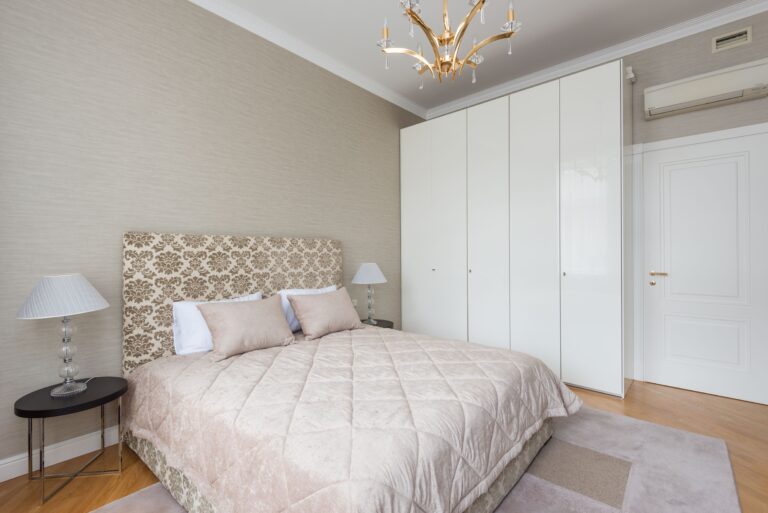
- The command position, always. The bed should have a clear sightline to the bedroom door without being directly aligned with it. Diagonal placement from the door is the classical ideal.
- Equal access from both sides. Asymmetry in bed accessibility (pushed against one wall) creates energetic imbalance and, according to the philosophy, invites one-sided relationships — personal or professional.
- Bed height off the floor. Chi should circulate beneath the bed freely. Avoid under-bed storage when possible; where storage is essential, keep it orderly and closed.
- Never align the bed directly with the door. The “death position” in classical feng shui — feet pointing directly toward the door — is also simply poor sleep ergonomics: it positions the sleeper in the room’s main traffic line.
Mirrors and Screens — Handle With Care
Mirrors in the bedroom are the source of more feng shui debate than almost any other element. The concern: mirrors activate energy (Yang) in a space that should be cultivating rest and stillness (Yin). A large mirror reflecting the bed, particularly, is considered energetically disruptive to sleep.
The practical translation: if you cannot remove bedroom mirrors, orient them away from direct bed reflection — toward closets, toward the side wall, or behind a panel or curtain that can be closed at night. Similarly, screens (laptops, televisions) introduce the same Yang activation. Keep them out of the bedroom; where that is impossible in a studio, face them away from the sleeping zone when not in use.
Colour, Texture, and the Yin Palette
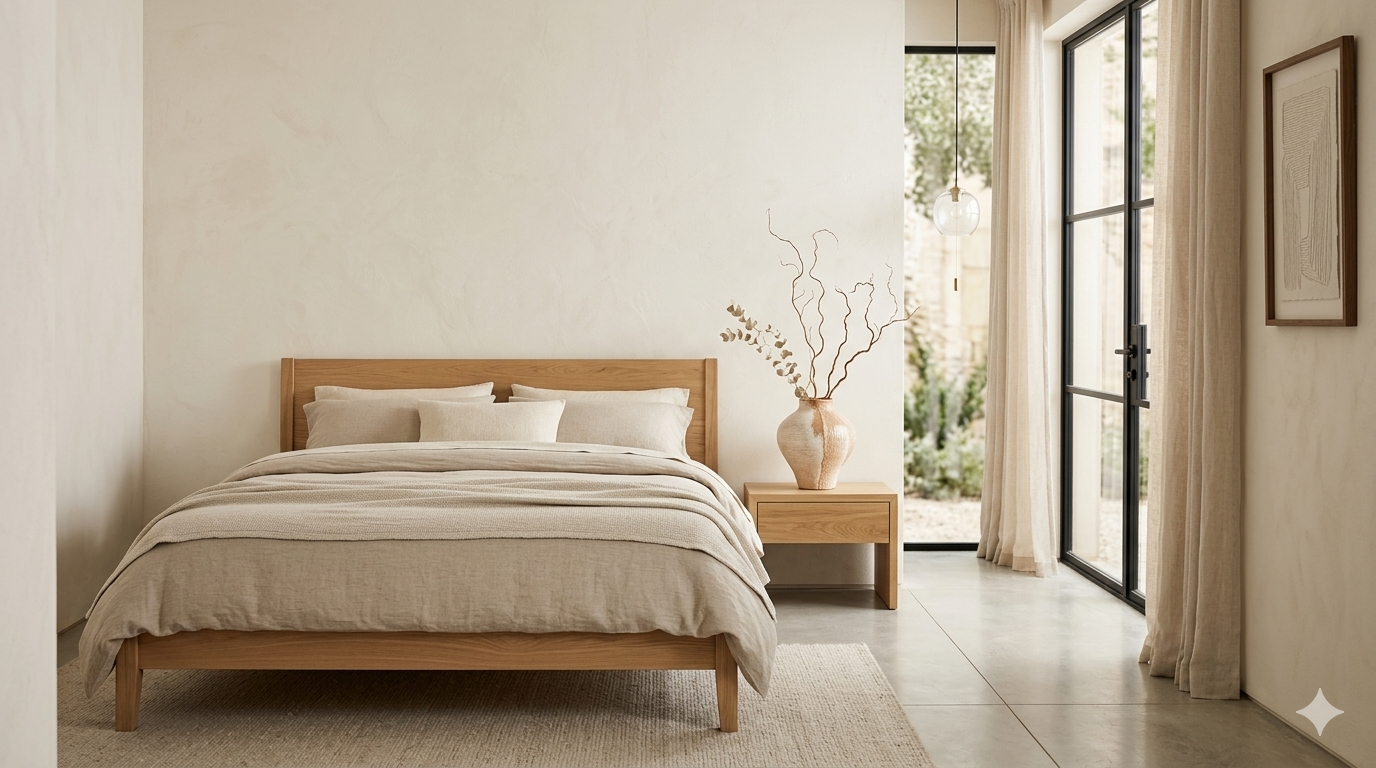
In feng shui interior design, the bedroom benefits from a deliberately Yin palette: warm neutrals, soft terracottas, sage greens, dusty rose, stone. These tones invite the nervous system into a lower register — which is precisely where rest begins.
Texture is the bedroom’s quiet luxury: layered natural linens, a sheepskin at the foot of the bed, a low woven rug underfoot. These materials introduce the Earth and Wood elements simultaneously, grounding the space without weight.
- ☐ Bed in command position — diagonal from door, sightline clear
- ☐ Solid headboard against wall — no floating, no windows behind
- ☐ Matching bedside tables — both sides of bed accessible
- ☐ Mirrors re-oriented — not reflecting the sleeping body
- ☐ Screens absent or concealed — no direct TV/laptop facing the bed
- ☐ Warm, layered lighting only — no overhead cold fluorescents in the evening
- ☐ Yin palette established — warm, muted tones dominating
- ☐ Under-bed clear — or concealed with closed storage only
The Minimalist Intersection:
Modern Feng Shui in Practice
There is a reason that the most compelling contemporary interiors — the ones that appear in the pages of Architectural Digest and Kinfolk, the ones pinned obsessively on design boards — so often align with feng shui principles without naming them as such.
Minimalism, as a feng shui interior design philosophy, is not merely aesthetic restraint. It is the deliberate reduction of spatial noise to allow what remains to speak at full volume. This is, functionally, the same aspiration as feng shui’s pursuit of unobstructed Chi flow.
“Minimalism is not about having less. It is about making room — for light, for movement, for the things that actually matter to you.”
Consider the feng shui interior design examples that resonate most in the contemporary urban context: the Japanese apartment where a single ikebana arrangement on an otherwise bare surface becomes the room’s entire emotional statement. The Scandinavian studio where a linen sofa, a brass floor lamp, and three carefully chosen books constitute a complete visual world. The New York one-bedroom where a raw-edged stone console and a single monstera plant transform a white corridor into a considered threshold.
These are not accidents. They are the product of the same logic that feng shui has always practiced: the most powerful object in a room is often the one you chose not to add.
The Studio Apartment as Feng Shui Laboratory
The constraints of a small apartment — far from being obstacles to feng shui interior design principles — are actually its ideal proving ground. When you have 500 square feet, every object must earn its presence. Every piece of furniture must serve multiple functions without obscuring the room’s spatial logic. Every surface must be edited with a kind of quiet ruthlessness.
The studio renter who applies feng shui interior design rules is not working against their space. They are working with its inherent demand for intentionality — and discovering that a smaller, more considered world is, in almost every way, a richer one.
Begin with one room. One wall. One surface. Clear it entirely, and ask: what needs to return, and what was simply there because it had nowhere else to be? The answer, more often than not, reveals the edit — and the edit reveals the room’s true capacity for beauty.