CubeSmart Self Storage: The Minimalist’s Blueprint for Urban Space
CubeSmart Self Storage solutions have quietly become the defining infrastructure of the modern urban minimalist — a system designed not for accumulation, but for the precise curation of a life worth living.
In this comprehensive guide on CubeSmart Self Storage, VEPLAT explores everything you need to know about smart storage for luxury apartments: how to choose the right unit, what to store and when, and how to deploy off-site storage as a strategic tool for elevated urban living. This is not a guide to accumulation — it is a guide to intentional space.
What Is Smart Storage for a Luxury Apartment?
Smart storage is the deliberate management of possessions so that only what is actively in use occupies your living space. It is not minimalism for its own sake — it is the recognition that a well-curated environment requires a clear boundary between what belongs in your home and what belongs elsewhere.
For urban renters — including those navigating competitive markets or finding pet-friendly apartments for rent in NYC — that boundary is often a climate-controlled storage unit within a few minutes of home. Used intentionally, it functions as an extension of your interior — a seasonal archive, a wardrobe annex, an object library — rather than a secondary option for things you no longer want but haven’t yet released.
The distinction matters. Smart storage for luxury apartments is an active system, not a passive one. It requires the same editorial precision you apply to what enters your home — and the same willingness to make clear decisions about what belongs where. Read more about this philosophy in our guide to biophilic design interior design, where spatial clarity is treated as a fundamental condition of wellbeing.
Why Smart Storage Suits the Modern Minimalist
The minimalist does not simply discard — they curate. Off-site storage provides the physical infrastructure that makes true curation possible without forcing premature decisions about objects that carry seasonal, sentimental, or investment value.
A well-designed apartment does not demand fewer possessions. It demands that every possession has its correct place. A cashmere coat stored properly in a climate-controlled unit from April to October is not absent from your life — it is simply correctly located. The same applies to art prints, vintage accessories, collector objects, and furniture awaiting a future space.
“The home should hold only what is actively in use. Everything else deserves a space of its own — maintained, preserved, and accessible.” VEPLAT Editorial Philosophy
This approach connects directly to the principles we explore in our guide to Feng Shui interior design — specifically the idea that spatial clarity is not emptiness, but the active condition that allows a room to breathe and function at its highest register.
What to Look for in a Smart Storage Unit
Select facilities also offer wine storage vaults and vehicle bays — extending the proposition well beyond standard self-storage into genuine lifestyle infrastructure for the urban collector and design-conscious renter. For reliable networks, major providers like CubeSmart Self Storage offer structured digital management systems across multiple locations (you can verify branch details via platforms like Yelp or Storage.com).
How to Choose the Right Storage Facility
Choosing a smart storage facility for your luxury apartment requires strategy, not just proximity. The following four-step process will guide you to the correct location with precision and confidence.
Storage Unit Sizes: The Curator’s Guide
Understanding which unit size maps to your inventory is the first editorial decision in any serious storage strategy. The following table maps unit dimensions to curated use cases for the urban luxury renter.
| Unit Size | Curated Use Case | Approximate Capacity | Est. Monthly Rate |
|---|---|---|---|
| 5 × 5 ft Entry | Seasonal décor, archive boxes, art prints, vintage accessories | Walk-in closet equivalent | $50 – $90 |
| 5 × 10 ft Studio | Studio apartment overflow, wardrobe rotation, bicycles, luggage | Standard bedroom | $80 – $140 |
| 10 × 10 ft Suite | One-bedroom apartment contents, furniture, statement objects | Single garage | $110 – $200 |
| 10 × 20 ft Estate | Full household, vehicle storage, collector-grade inventory | Double garage | $180 – $350 |
Climate-controlled units command a 15–25% premium over standard offerings — a worthwhile investment for anyone storing materials sensitive to temperature or humidity fluctuations.

The VEPLAT Method for Smart Storage Curation
Deploying smart storage strategically requires a curation system, not a relocation instinct. The following method, developed through The Art of Urban Rental Living, treats storage as an extension of interior design logic.
Four Principles of Intentional Storage
-
Categorise before packing. Divide all items into three groups: active rotation, long-term preservation, and review-pending. Never mix categories within a single unit. This single discipline prevents the gradual slide from curated archive to accumulation warehouse.
-
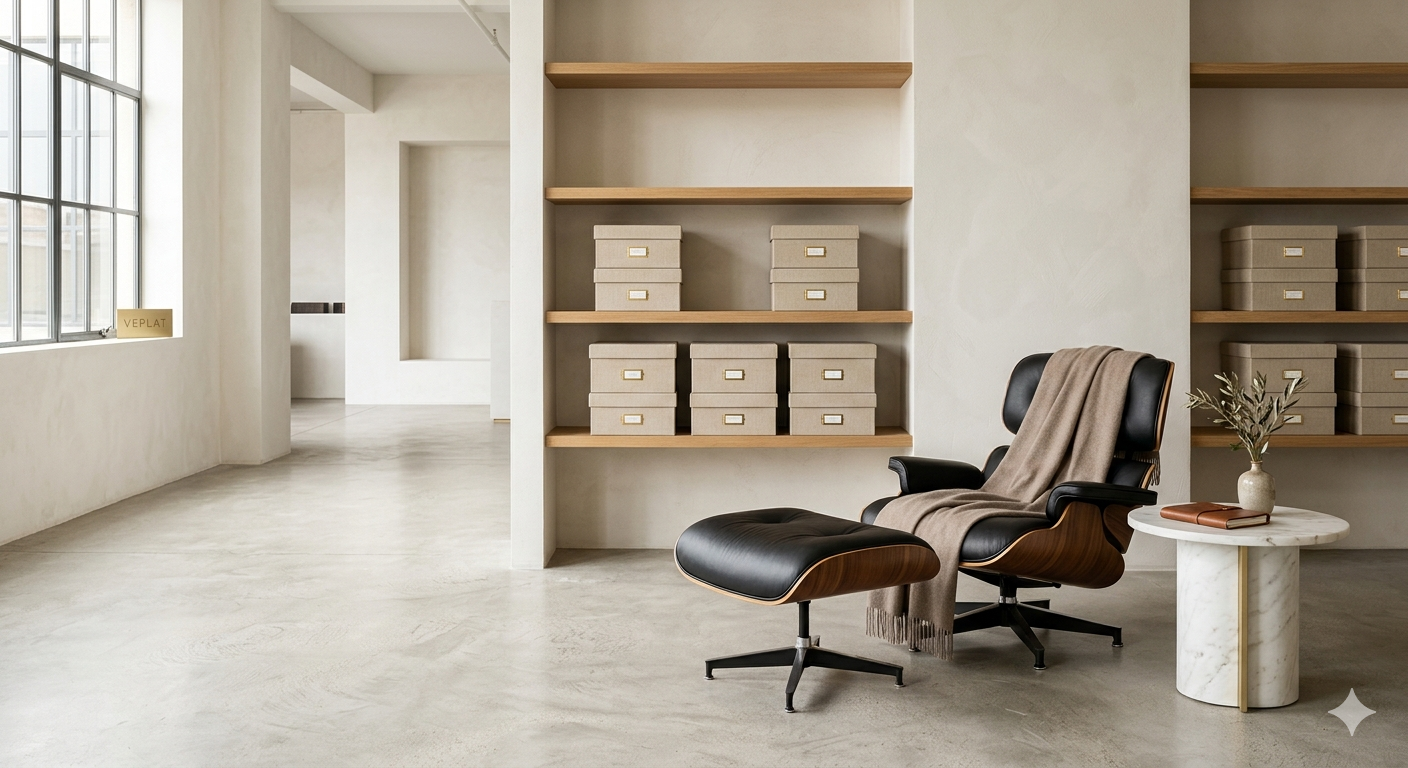
Invest in archival packaging. Acid-free tissue, custom garment bags, and double-walled archive boxes are the infrastructure of preservation. Label every container on a minimum of three surfaces for rapid retrieval. The quality of your packaging reflects the value you assign to what’s inside.
-
Document photographically. Before sealing any box, photograph its contents. Maintain a digital inventory — a structured spreadsheet suffices. Photographic records are essential for insurance claims, estate management, and simple peace of mind.
-
Schedule quarterly reviews. A storage unit must not become a static repository. Allocate ninety minutes every quarter to rotate, reassess, and release. Your storage should evolve alongside your life — not accumulate in spite of it.
Smart storage is, in our editorial assessment, one of the most underutilised tools available to the urban renter. The investment — typically $80–$140 per month for a well-chosen unit — delivers a transformation in daily living quality that no piece of furniture can replicate: the experience of a home that contains only what is actively serving your life.
Use it as an extension of your interior design logic, not as overflow. Rotate seasonally. Review quarterly. Release without sentiment. The apartment that results is not emptier — it is more precisely itself. This is the biophilic design principle applied to possession: every object in its correct place, and every space allowed to breathe.